
Small paintings
That was a bit of a maze, but I haven’t lost you yet. We have only just mentioned frescos in passing at the start.
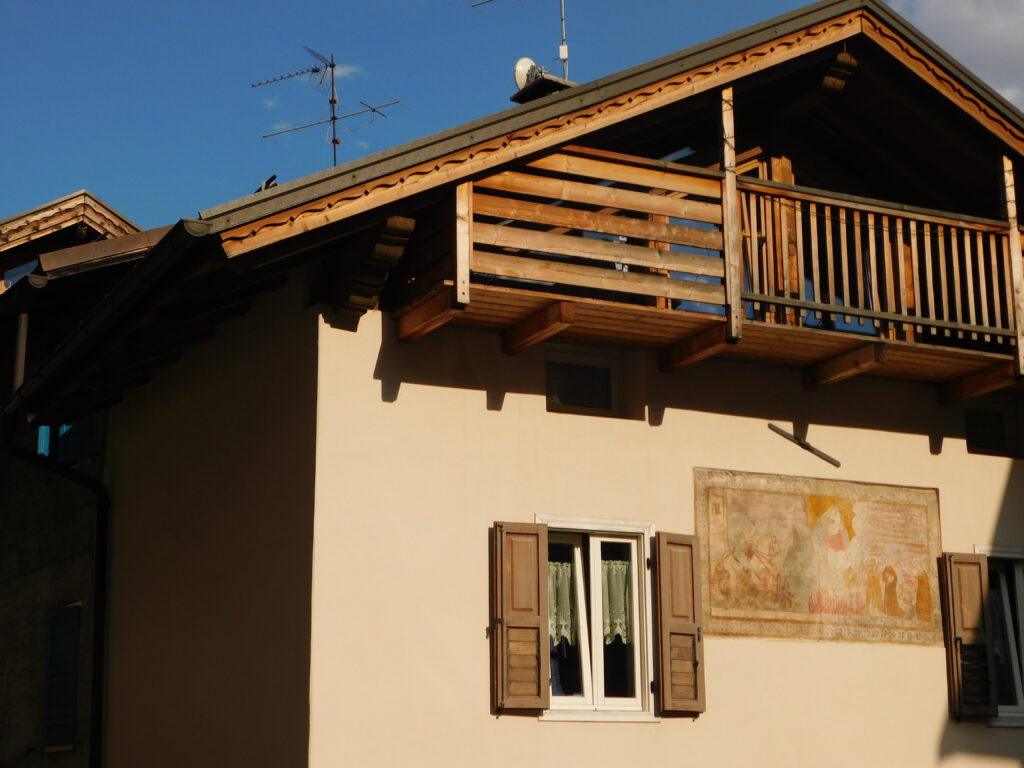
Here we can see two, one after the other. The one in front of you is dated 1652. It depicts St. George and the dragon with the princess up on the hill.
In the centre the souls that have been saved from the flames are being accompanied to heaven in the presence of the Madonna and child. To the side one can see St John, St Romina and St. Francis.
A nice little detail to the top left: a woman is watchfully looking down at the road from her window. I have an idea she was a gossip and know-it-all too. The central scene is dedicated to the Virgin, portrayed here holding the child and standing in a circle of light; on the lower part, under the white clouds that build up a throne for her, one can see some souls burning in the fire of the Purgatory.
With this painting the commissioner wanted to ask for the Virgin’s intercession for a relative to quickly ascend to Heaven.
In fact, just above the souls, not even the faded paint and the scratches can fully conceal the figure of an angel, who seems to take one of those souls by the hand and take them with him. The whole scene is completed by three Saints kneeling, who are recognizable by the typical features linked to them and by their names written on a sash just underneath: John the Baptist wearing leather clothes, Francis of Assisi with the stigmata, and Romina (the name of Saint Felicitas of Rome) next to the dead bodies of her two sons killed in front of her to force her to abjuration.
On the background of the two lateral scenes, you can see a grey-blue sky speckled in pink, representing a calm and quiet atmosphere in spite of the dragons, flames and slaughtered children. The painting was made by Zouane Focelini. Unfortunately, during restoration works, the broken word [Purga]tory and the artist’s signature were misspelled.
The frescos painted on the facades of the houses are a figurative expression that was commonly used. Most of the paintings are along the main streets which were also the routes used for religious processions.
Together with statues in niches, and crucifixes, they are a testimony to a profound religious faith and genuine spirituality. The totem on the right will give you further information. On the street slightly sloping up to your left you will see another fresco: the crucifixion. Again, we can see St. Romina, together with St Antony the Abbot. One recognises in the man kneeling, the person who commissioned the fresco, a rare find in wall murals.
“Stoli” & the old washouse (“lisiera”)
Uphill again! Had I not said that it was all downhill…
The house with the blue shutters and kitchen gardens
The Bond house has blue shutters which…